













Empresa
26 September 2026
 12:11
12:11 Allen Wang | CEO and Founder, HIPAD
Updated: September 7, 2026
A short track sliding door system links two moving leaves through a belt-driven 2+1 synchronized layout. For an OEM quotation, confirm the 70 mm buffer stroke, 35–100 kg door-weight range, 520 mm minimum leaf size and the installation clearances before approving a drawing.
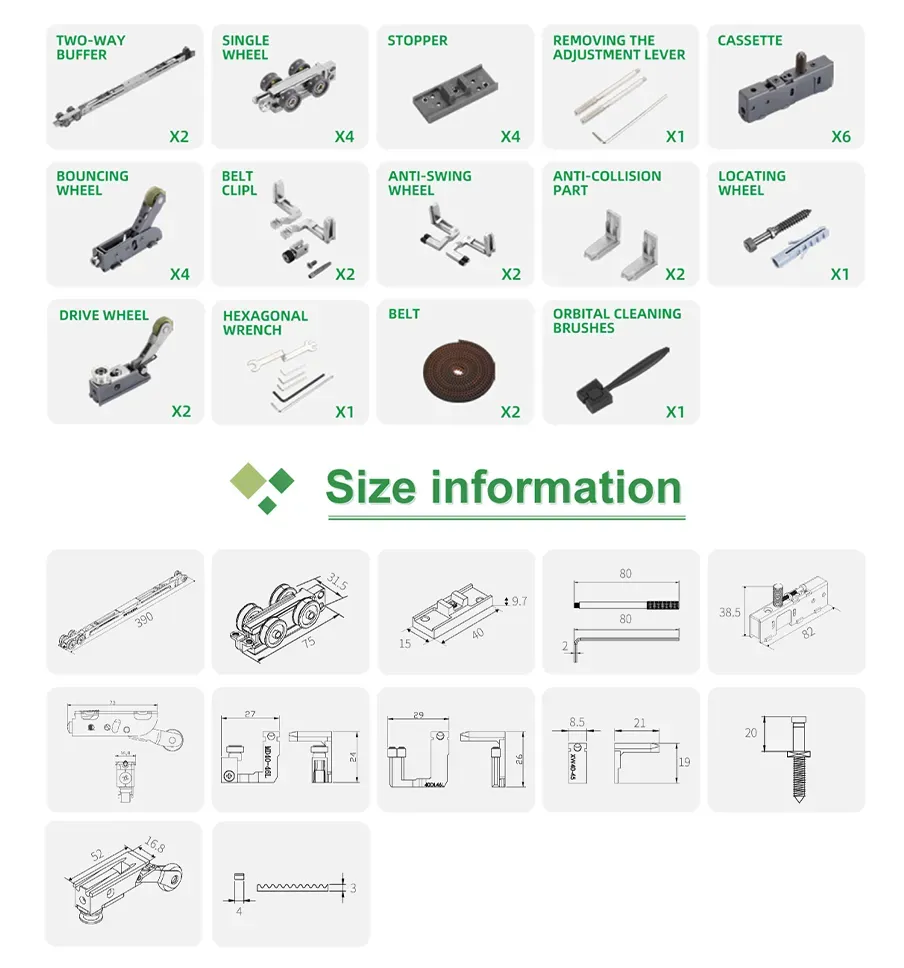
The 2+1 system is a short-track, low-track sliding arrangement in which the moving leaves are coordinated by a belt-driven mechanism. The published HIPAD product reference describes a metal-and-plastic construction, a 70 mm buffer stroke, a 35–100 kg door-weight range, an 80,000-cycle stated service life and a minimum 520 mm door leaf size.
These are product-reference values, not a substitute for a model drawing. Glass thickness, frame profile, track preparation and the final door assembly must still be checked together.
| Specification | Published reference | Buyer confirmation |
|---|---|---|
| Tipo de sistema | Belt-driven synchronized short-track / low-track system | Opening direction, leaf sequence and available track length |
| Buffer stroke | 70 mm | Buffer location, end clearance and soft-stop behavior |
| Door weight | 35–100 kg | Actual finished leaf weight including glass, frame and hardware |
| Minimum leaf size | 520 mm | Leaf width, overlap and required passage width |
| Service-life reference | 80,000 cycles stated | Test method, load condition and acceptance definition |
| Construction | Metal + plastic components | Part-level materials, wear surfaces and finish exposure |
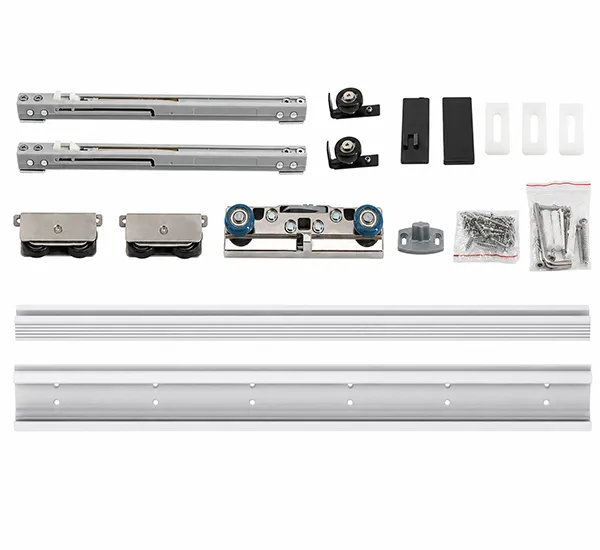
A door that falls inside the 35–100 kg range is not automatically compatible. A leaf can meet the weight limit while failing the minimum width, overlap, track clearance or fixing geometry. Do not treat the 80,000-cycle statement as a project warranty; request the test condition and confirm that it represents the installed configuration.
Compared with a conventional single-leaf roller set, synchronized hardware can simplify coordinated movement, but it adds belt routing and adjustment points. Those parts need access for inspection and replacement.
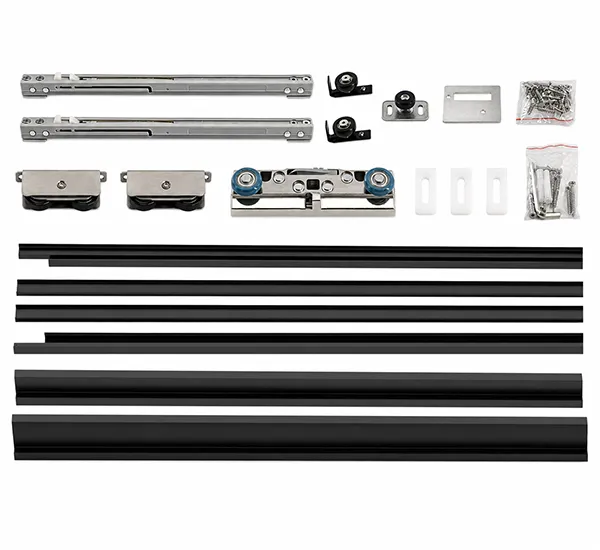
The source library identifies metal and plastic construction for this system but does not disclose a product-level certificate number or universal price. Ask for the exact material of the track, rollers, belt hardware, guides and fasteners, along with finish and environmental requirements. Price, MOQ and lead time require a project quotation.
HIPAD describes drawing-based OEM/ODM development, structure adjustments, finish selection, branding and packaging support. Those capabilities should be confirmed against the selected model and order quantity rather than assumed from a catalog image.
For quality terminology, ISO 9001:2015 describes quality-management-system requirements; it is not a certificate of this sliding system’s cycle performance. Model-specific test evidence should be requested when a project specification requires it.
The reference range is 35–100 kg. Confirm the finished installed leaf weight and the supplier’s loading method.
It is the published buffer-stroke reference for the system. The drawing should show its location, travel and end-clearance requirement.
No. It is a stated service-life reference. Ask for the tested configuration, load and method before using it as a project acceptance criterion.
Drawing-based customization, structure adjustments, finishes, branding and packaging can be discussed. Feasibility depends on the door geometry, quantity and requested changes.
Include the door profile, leaf dimensions, finished weight, opening direction, overlap, track length, floor condition, finish, quantity and inspection requirements in the RFQ. Review the related sliding door fitting guide, door roller hardware specifications, sliding glass door hardware guide y custom door hardware OEM guide before you contact HIPAD for a model-specific review.
Allen Wang is CEO and Founder of HIPAD. He began as a technical engineer in 1998 and focuses on practical manufacturing, tooling, quality, OEM/ODM development and architectural hardware supply.
Responderemos en un plazo de 24 horas. Para solicitudes urgentes, contáctenos por WhatsApp/WeChat al +86 137 9191 8989 o llame directamente al mismo número.
*Respetamos la confidencialidad de sus datos y protegemos toda la información.
Solo utilizaremos sus datos para responder a su solicitud y nunca enviaremos correos no solicitados ni mensajes promocionales.